Scientific Calculator Plus 991, NCalc or CalcES?
An illustrated comparison of Scientific Calculator Plus 991 on Android, NCalc on iPhone and CalcES on the web: real interfaces, algebra, graphs, offline use and cost.
You need a scientific calculator on your phone. You could install one and keep it a tap away, or use a browser calculator that follows you onto a laptop. Both approaches can handle more than basic arithmetic. The useful question is what happens when the problem grows, the connection drops, or you move to another screen.
This comparison covers Scientific calculator plus 991 on Android, Scientific Calculator Plus 991, called NCalc in its iPhone listing, and CalcES in the browser. The two store apps have similar names, but they are separate releases; we do not assume every feature works identically on Android and iOS.
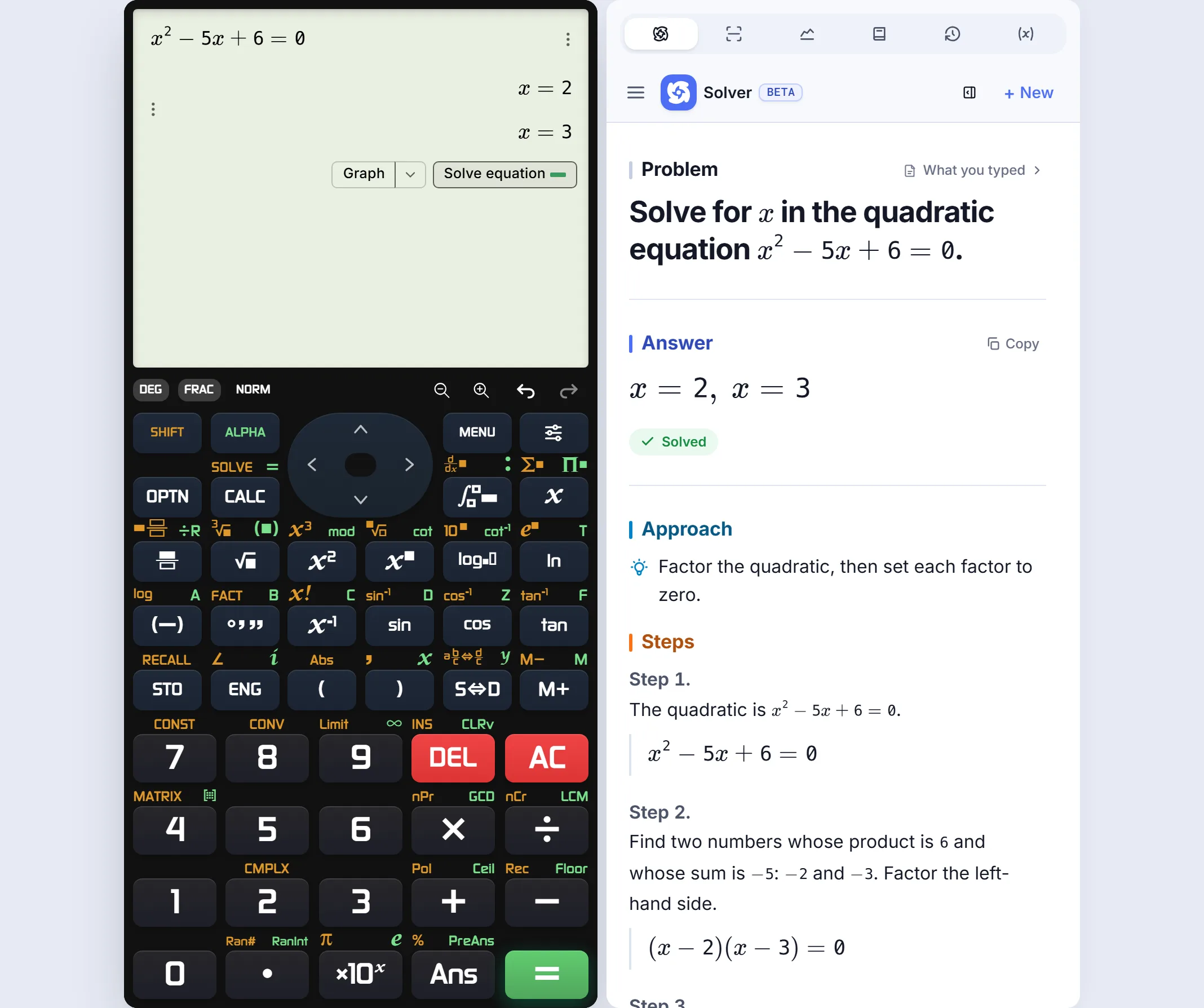 Real CalcES tablet capture: x²−5x+6=0 stays beside its supported worked solution.
CalcES is made by MathDa, which publishes this Journal. We checked the Google Play listing and App Store listing on 25 September 2026. Their images below are the publishers' store screenshots, while the CalcES images are captures of a working session. We have not run a common speed or accuracy benchmark on all three.
Three routes to a scientific keypad
| Android app | iPhone app | CalcES web | |
|---|---|---|---|
| Where you use it | Installed on an Android phone | iPhone; the listing also names iPad and Mac | Browser on phone, tablet or computer |
| Input and math | Listing describes familiar 300/115/991-style layouts, equations, calculus, symbolic math and graphs | Listing describes natural display, exact fractions, equations, calculus, matrices, graphs and a formula library | ES PLUS, EX and CW-style keypads, natural input, equations, symbolic work and graphs |
| After a result | Graphing and other modes are described; the exact handoff between them still needs a device check | History and graphing are described; the exact handoff still needs a device check | For supported problems, open Tales worked steps or a graph from the result without re-entering it |
| Access and cost | Install; Google Play marks ads and in-app purchases | Install; free download with in-app purchases | No install; free to use in a browser, with network access needed for full calculation services |
| History across devices | Not verified for this comparison | On-device history is listed; cross-device behavior not verified | Sign in to sync calculation history |
This is a choice between an Android app and the web on Android, or an iPhone app and the web on iPhone. The three columns are not a claim that one person needs all three.
First check the keypad you actually know
The Android listing groups several calculator styles under one app, including 300, 115 and 991, and describes layouts familiar to 991 ES PLUS and 991 EX users. The iPhone listing specifically names 115 ES Plus, 991 ES Plus, 300 ES Plus and 991 EX layouts. That matters more than a “991” in the app title: open the store screenshots or the app and check the keys you intend to practise with. Android listing · iPhone listing.
CalcES lets you choose a keypad family too, including ES PLUS, EX and ClassWiz CW styles. If you work with an fx-991ES PLUS, fx-991EX or fx-991CW, select the corresponding CalcES style before judging the feel of entry. CalcES is an independent product, not a Casio app, and matching a keypad family does not promise that every menu or operation exactly matches a handheld.
A useful natural-input check is , not a bare string of digits. CalcES keeps the fraction and radicals in two-dimensional notation and returns the exact result 3. The full-keypad image below keeps both the expression and the keys in view.
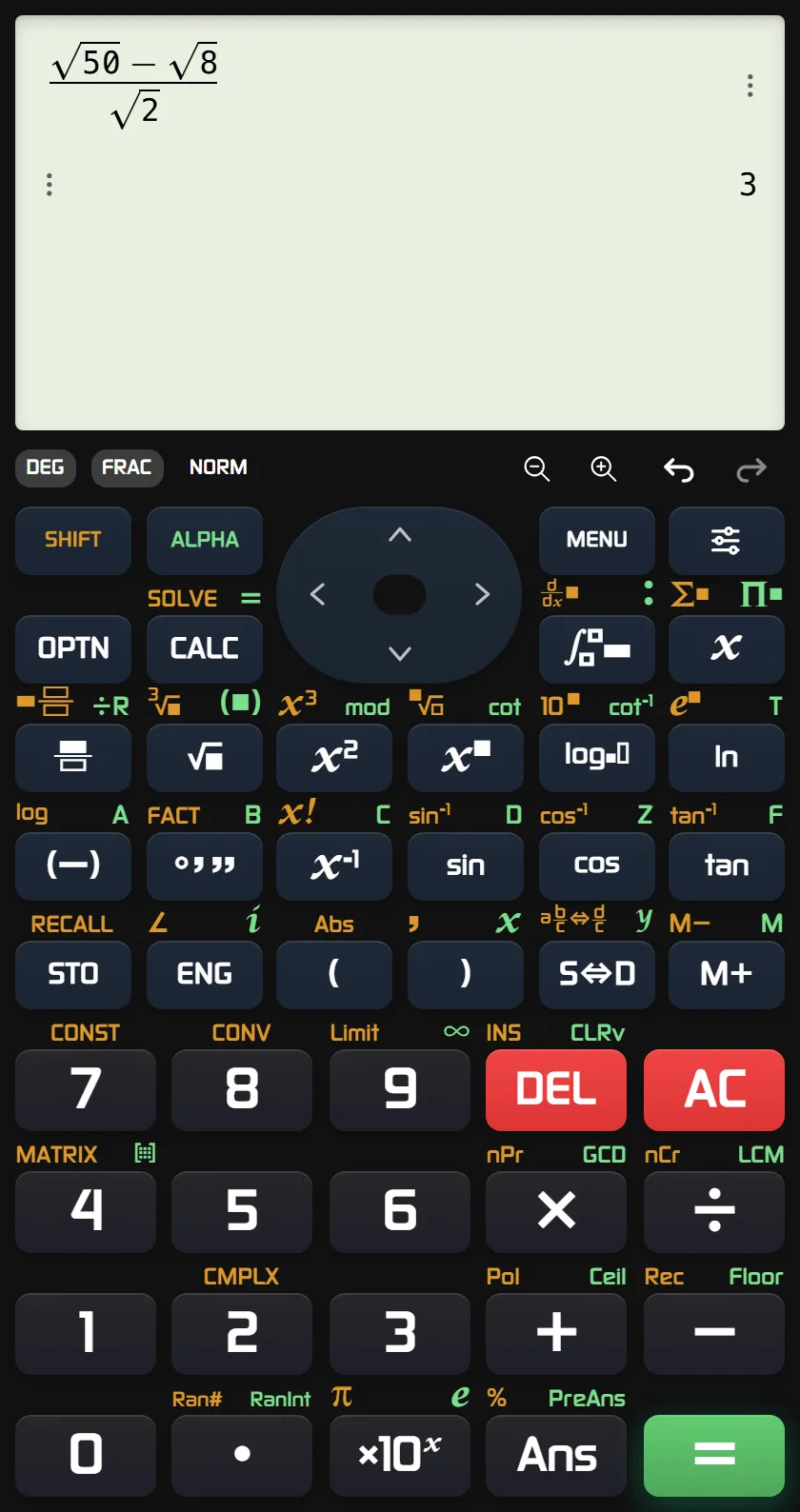 Real CalcES capture: (√50−√8)/√2 stays in natural notation and evaluates to 3.
The store images make the layout difference easier to see. They show different example problems from the CalcES capture above, so they are evidence of the interface, not a claim that we ran the same input in all three apps.
Android: dense keys and a separate detail view
The Android store screenshot shows a full scientific keypad, with SHIFT and ALPHA keys, a natural-looking expression display and a result-format menu offering decimal and fraction views. This resembles the crowded, function-rich board many handheld users expect. It also means the small phone screen carries a lot of keys; decide whether that is comfortable on your own device.
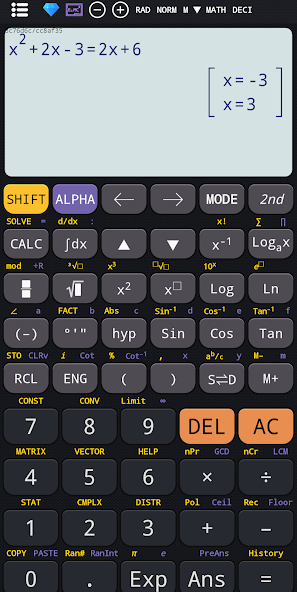 Google Play publisher screenshot, checked 25 September 2026. It shows the Android keypad and result formats; it is not our device benchmark.
Another store screenshot shows an expression-details page with exact equation roots and a graph below. That is more informative than a feature list: the app can present an algebra result and visual context together, though the screenshot alone does not establish which actions lead there.
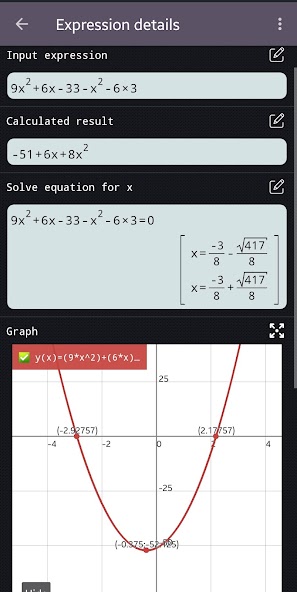 Google Play publisher screenshot: the Android app's expression-details view includes an equation solution and a graph.

iPhone: a different presentation of the same kind of work
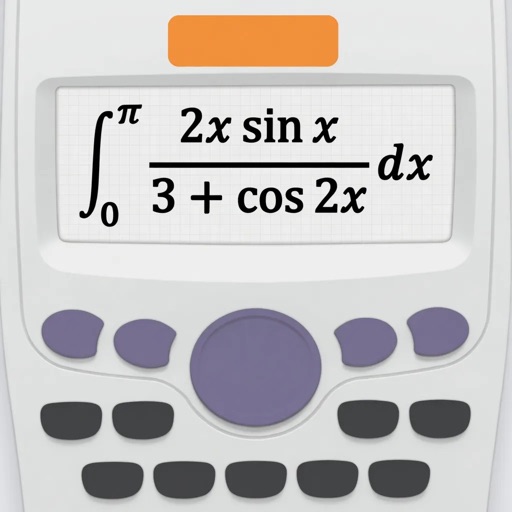
The iPhone store images give natural notation and a running calculation display more space. One image shows several algebra calculations on the phone; another shows an equation's exact roots above its graph. The latter includes publisher advertising text around the phone frame, so judge the screen inside the frame rather than treating the artwork as a hands-on test.
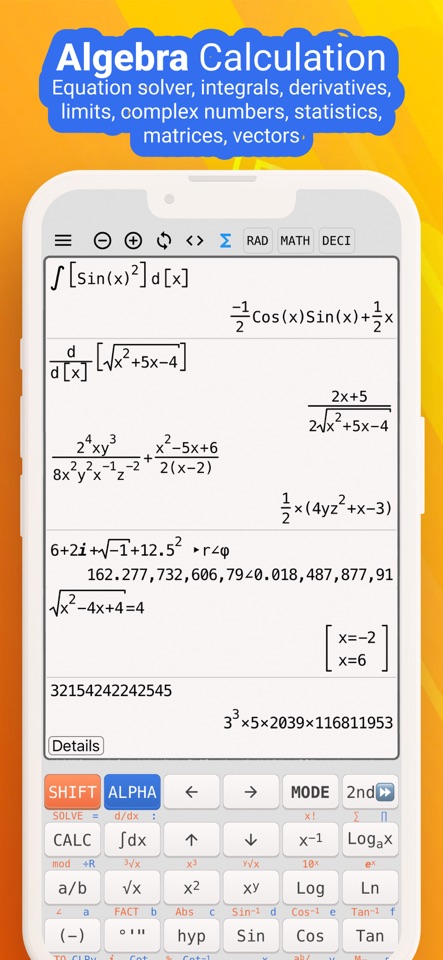 App Store publisher screenshot, checked 25 September 2026. The pictured iPhone shows the app's algebra display.
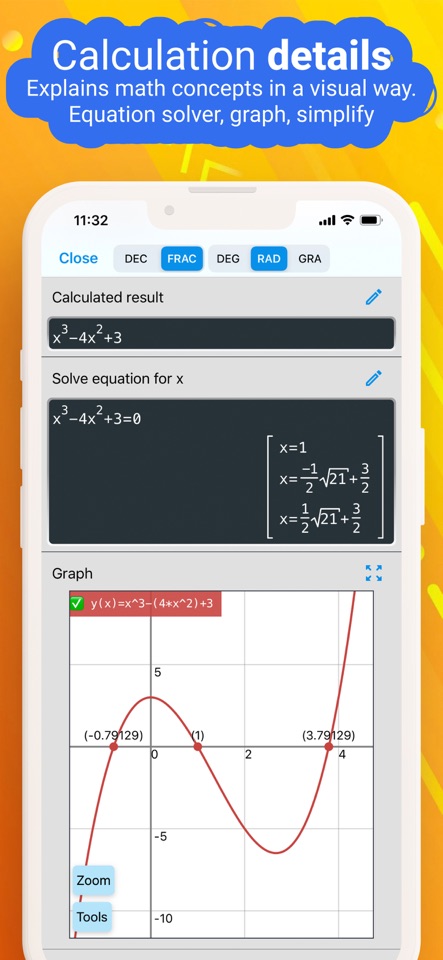 App Store publisher screenshot: exact roots and a graph appear together in the pictured app screen.

When the answer is only the start
Try a question with more than one useful output: . You may want its two roots, a reason they are roots, and a graph showing where the curve crosses the axis. All three products are positioned to do advanced mathematics. Google Play describes equation solving, symbolic calculation and graphing; the App Store describes general and dedicated equation solvers, symbolic and numeric modes, and several graph types. Neither app should be dismissed as a four-function calculator. Android listing · iPhone listing.
For this particular equation, factoring gives , hence and . Substituting either value back into the original equation is a quick check even if you use a different app. A graph adds another piece of information: the parabola crosses the axis at those two values and lies below it between them. The factorization establishes the exact roots; a graph makes the interval visible.
The CalcES difference we can show directly is its result handoff. On supported problems, the control below the answer passes the current expression to Tales Math Solver or the integrated graph panel. The problem remains on the calculator while you inspect the steps or curve. It is a useful study flow when you need more than the final number, though worked steps are not available for every expression CalcES can evaluate.
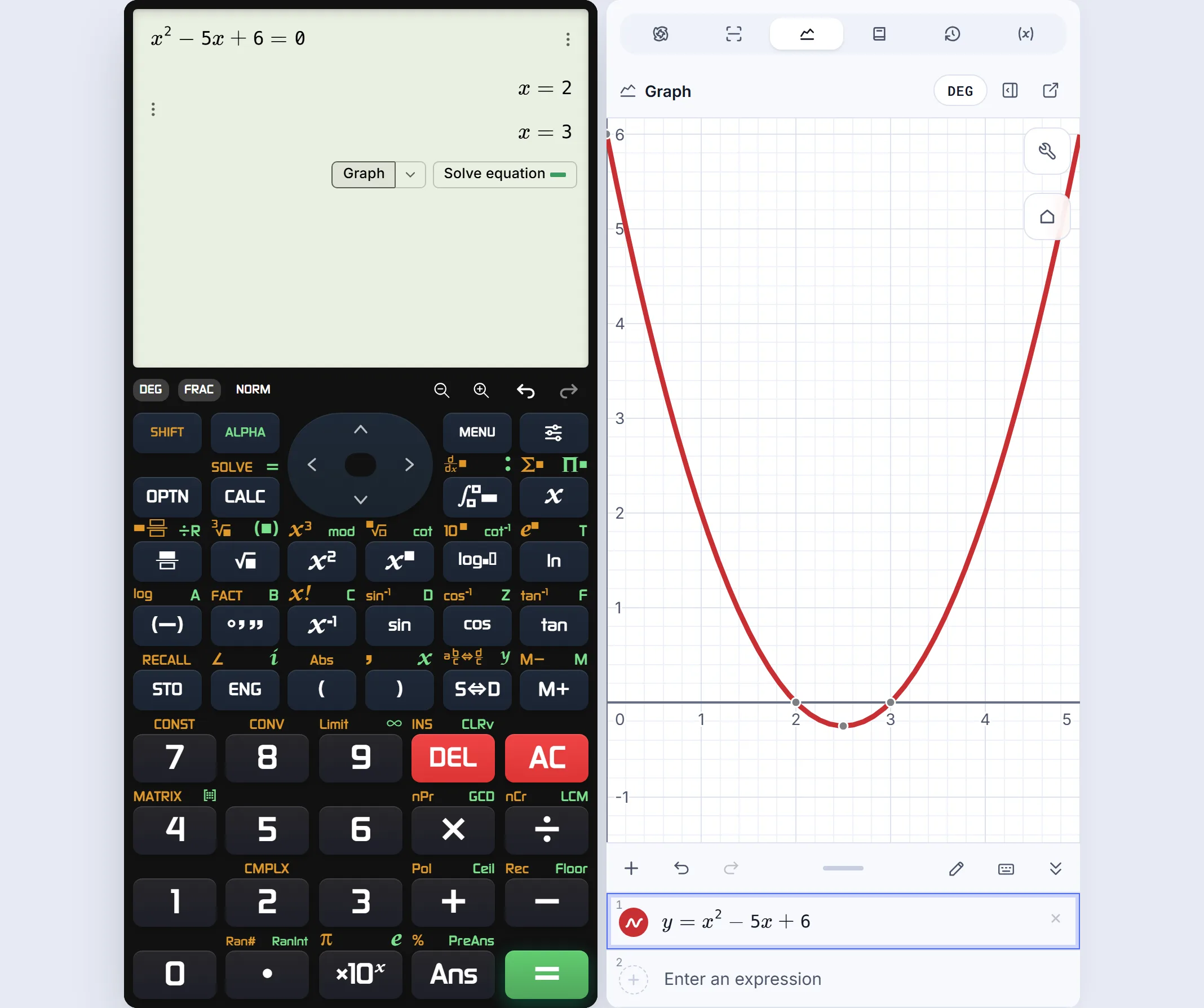 The same quadratic appears in CalcES and its graph panel after the result handoff.
The Android and iPhone store images above also show equation results with graphs. Their example problems differ from the CalcES quadratic, so this is a comparison of the available views, not a head-to-head score for one calculation. Both mobile listings describe substantial graphing of their own; the iPhone listing includes implicit, polar and parametric plots, and the Android listing describes those graph families too. The listings do not establish how many taps it takes to move a particular calculation into a graph or a worked explanation. We will not assign a workflow winner on that question without identical hands-on captures from both apps.
What the installed apps add
The Android app listing goes beyond keypad emulation: it names matrices, vectors, complex numbers, a formula collection, unit conversion, themes, fonts and programming. That breadth can be useful if your work jumps between school exercises and technical calculations. It also makes the real menu structure worth checking; a long feature list does not tell you which tool is quickest to reach.
The iPhone listing describes statistics and probability distributions, multi-variable systems, user-defined functions, number bases, formulas and unit or currency conversion. For someone who needs those tools repeatedly on an iPhone or iPad, NCalc may be the better daily home than opening a browser for each task. Fresh exchange rates are a different offline question from local arithmetic.
Offline use, history and price
An installed app makes sense for calculations on a bus or anywhere coverage is unreliable. Before relying on it, turn on airplane mode and try the exact function you need. Local arithmetic and a currency converter that fetches current rates are different cases. CalcES needs a connection for its full calculation and worked-solution services.
At home on a laptop, a full-width keyboard and room for an adjacent explanation or graph may matter more. You can use the mobile app while travelling and CalcES at your desk. CalcES also syncs calculation history when you sign in. The iPhone listing advertises history on the device; it does not establish equivalent cross-device sync for this comparison. Check that difference if you move unfinished work between screens.
Google Play labels the Android release as containing ads and in-app purchases. The iPhone app is free to download and offers in-app purchases, including subscriptions in its description. CalcES is free in the browser. Those labels do not tell you how often an ad appears or which functions are behind a purchase; check the current listing for your own device. Google Play · App Store.
What should you pick?
- Android phone, installed keypad and intermittent connection: start with Scientific calculator plus 991. Check its selected keypad and the free version's ad experience.
- iPhone or iPad, natural math display plus graphing and converters: look at Scientific Calculator Plus 991 / NCalc. Check which functions are free before paying.
- Phone and laptop, or a problem that needs a supported worked explanation beside the calculator: open CalcES. Its quadratic Guide covers the model-specific keys; this comparison is here to help you choose a tool.
All three are study and everyday-work options. For an exam, use the equipment permitted by that exam's current rules.
CalcES
Try the same problem on the web
Keep the article’s example or enter your own expression. CalcES opens with that problem, ready for a result and supported steps or graphs.
Frequently asked questions
Is Scientific Calculator Plus 991 the same app on Android and iPhone?
The Google Play and App Store listings share that name, but describe different releases and purchase options. The iPhone listing also calls its app NCalc. Check the listing for your device rather than assuming the features and interface match exactly.
Which option works when I have no internet connection?
An installed app is the practical choice for calculations when a connection is unreliable. Test the specific mode you need in airplane mode before relying on it. CalcES needs a connection for its full calculation and worked-solution services.
Do the apps have graphing and symbolic math, or only CalcES?
Both app listings describe graphing and advanced math, including symbolic capabilities. CalcES also has graphing and symbolic calculations. The distinct CalcES workflow is the handoff from a supported result to worked steps or a graph; this article does not claim that either app lacks those features.
Is CalcES a Casio calculator?
No. CalcES is an independent MathDa product with keypad styles for supported handheld model families. Casio does not make or endorse CalcES.
More in Reviews & comparisons
- Calculator Simulator or Online Calculator: Which Do You Need?
A model emulator, a familiar keypad and an online math tool solve different problems. We compare the choices with a real CalcES calculation and Casio's published emulator options.
- 10 Best Online Scientific Calculators for Casio Users
Compare 10 free scientific calculators by familiar fx-991ES PLUS, fx-991EX and fx-991CW-style keys, natural input, worked steps and graphs.